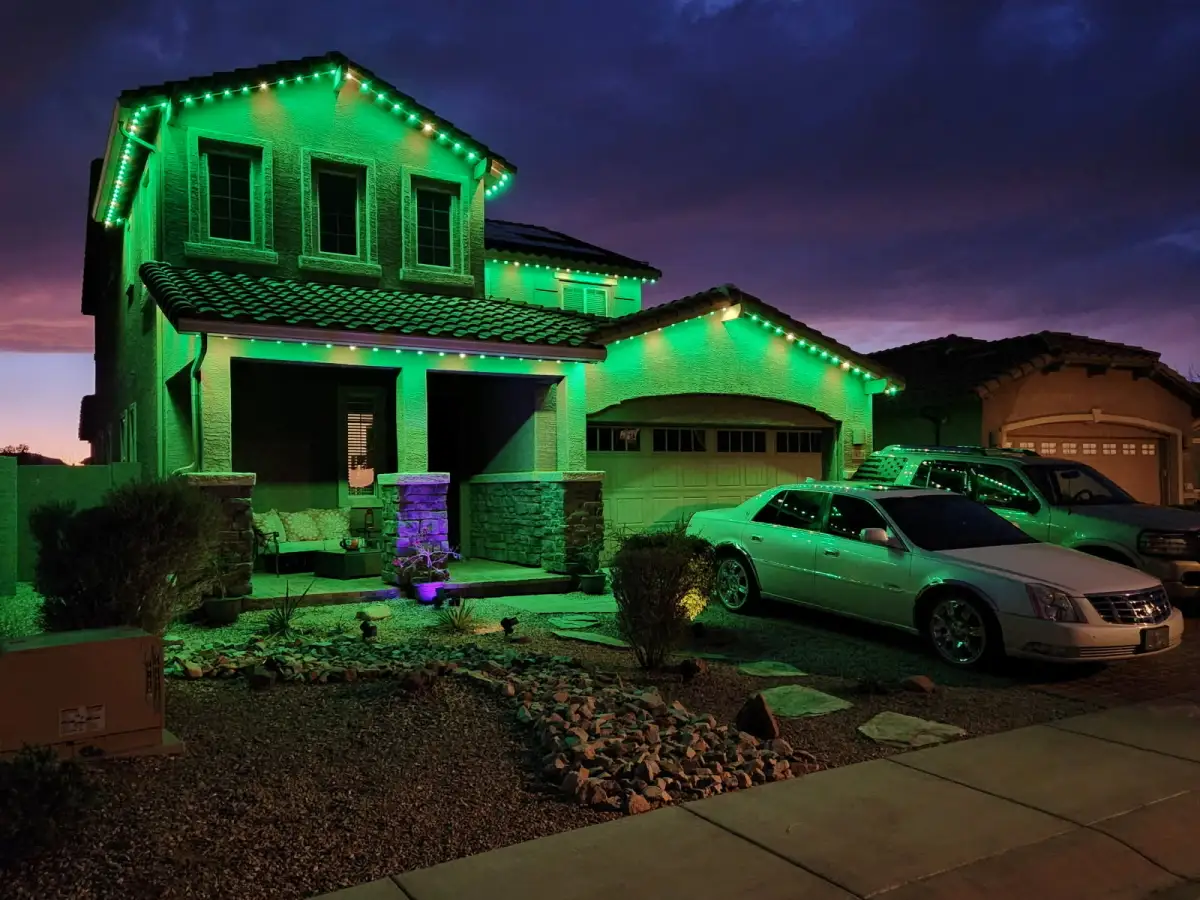
Real Omaha Home Transformations: Before and After Permanent Outdoor Lighting
See real permanent outdoor lighting Omaha NE homeowners love. Before and after results from Trulight Omaha show what's possible for your home.
What changes after a permanent lighting install is the edge of the house. Before, the roofline disappears at dusk and the house becomes a dark shape with two lit windows in it. After, the shape is drawn. That is the whole effect, and it is worth understanding what it looks like on your particular roof, because the same system produces very different results on a ranch, a two-story and a walkout.
TruLight's own installation photos are on the home page, along with a short video of an Omaha roofline moving from daytime track to warm white and color after dark. Below is what those changes actually consist of, house type by house type, and what the daylight half of the result looks like, which is the part nobody photographs.
Ranch homes: a horizontal line becomes the feature
Omaha has a lot of mid-century ranch stock, and it sits close to the street with a low, wide roofline. At night that geometry works against the house. There is no vertical mass to catch a porch light, so the whole front elevation flattens into a silhouette by about five o'clock in December.
Lighting the roofline on a ranch turns the one thing the house has plenty of, a long uninterrupted horizontal edge, into the thing you notice. Warm white running from one end of the fascia to the other reads as deliberate architecture rather than decoration. The common layout is a single continuous front run with optional accent drops at the garage bay headers, where the roofline steps down.
The mistake on ranches is lighting only the section over the front door. A partial run on a wide, low house looks like a strand of Christmas lights that ran out.
Two-story homes: the cut-off line is the thing to avoid
Two-story homes have more surface to work with, and more ways to get it wrong. The most common one is lighting the first floor eave and stopping. From the street that produces a bright band across the middle of the house with a dark upper half sitting on top of it, which looks worse than no lighting at all.
A two-story wants the full height addressed as one composition: the upper roofline, the gable rake lines, the dormers if there are any, and the porch or entry roof below. On homes with a projecting front gable, the rake line is usually the strongest single run on the house, because it is the only diagonal and it is what gives the elevation a shape after dark.
Zoning matters more here too. Most people want the upper roofline on every evening at warm white and the entry accent on a different schedule, and that only works if the two were wired as separate zones on install day.
Walkouts and hillside lots
A house that presents as one story from the street is often two and a half from the back yard. Lighting the front and leaving the rear elevation dark is a defensible choice on a budget, but it is worth deciding on purpose rather than finding out after the fact. The back of a walkout is usually where the deck, the patio and the actual evening use are.
What it looks like in daylight, which is eleven hours a day
This is the half of the before and after that people underestimate, and it is the reason to care what track is going up.
The channel is low-profile aluminum, roughly an inch wide, powder-coated to match your fascia or trim. Mounted correctly, it reads as a trim line from the curb. You have to be standing at the base of the house to identify it as equipment. A poorly chosen track color, or a channel that was not cut to follow the roofline properly, is visible every day of the year whether the lights are on or not.
That is also the question an HOA architectural committee is really asking. They are not deciding about your Christmas display. They are deciding what the street looks like in daylight for the other eleven months. If you are in a covenanted neighborhood, what to submit to an HOA for permanent roofline lights covers what goes in a submission that gets approved.
What permanent roofline lighting does not change
Worth saying plainly, because the before and after only covers so much.
It does not light the ground. A lit roofline defines the top edge of the house and leaves the walk, the driveway and the beds exactly as dark as they were. If the problem you are solving is finding the front door or getting from the car to the porch safely, that is accent lighting at walkways, columns and beds, and it is a separate set of zones on the same controller.
It does not fix a tired exterior. Roofline lighting draws the eye to the edges of the house, which means peeling fascia paint, a sagging gutter or a mismatched garage door all get slightly more attention, not less. Fascia condition has to be sound anyway before track goes on it, since the channel fastens into that board, so this often gets handled at the same time.
It does not change the daytime photograph of your house, beyond the trim line. Anyone showing you a daytime before and a night after is comparing two different things.
Judging a real before and after photo
Most of the photos you will see, from any company, are shot at dusk with the lights running color. Those are the flattering ones. Two things are worth looking for instead.
Look at a daylight shot of an installed house at normal viewing distance, not a close-up of the channel. Close-ups make the track look enormous. From the curb it should read as a line of trim.
Then look at a night shot in white rather than color. Even node spacing and consistent white across the whole run is what a careful install looks like. Dimming or a color shift toward the far end of a long roofline means power was fed from one point when it should have been injected at several.
The next step
Any honest picture of what your house will look like starts from measuring your house. TruLight installs permanent LED roofline lighting across the Omaha metro, and the estimate is free and done on site, with the roofline measured, zones planned and track color chosen against your actual trim before anything is ordered.
Call (402) 704-8151 or request an estimate.
Ready for an Omaha Roofline Lighting Estimate?
Call TruLight Omaha for a measured roofline estimate.
(402) 704-8151