7 Myths About Permanent Outdoor Lighting in Omaha NE: Debunked
Think permanent outdoor lighting Omaha NE is too expensive or inflexible? Trulight Omaha debunks 7 myths homeowners believe before calling.
7 Myths About Permanent Outdoor Lighting in Omaha NE: Debunked
Most of what stops Omaha homeowners from getting a permanent system is secondhand, and most of it is either out of date or an argument against a bad installation rather than against the product. Here are the seven we hear most, with the honest version of each, including the parts that are partly true.
Myth 1: It is too expensive for most homeowners
The comparison people run is a permanent system against a few strands from a big-box store, and of course it loses.
The comparison that holds up is against ten years of the alternative. Buying, storing, untangling, hanging, and replacing temporary lighting every year, or paying a crew to do it, and none of that money buys anything you keep. A professional hang-and-remove service is a subscription that renews every November whether you enjoyed the last one or not.
Most Omaha homes land between $1,500 and $4,500 installed: roughly $1,500 to $2,500 for a single-story front roofline and $2,500 to $4,500 for a two-story or a home with multiple gables and dormers. Most homeowners who switch find it pays for itself in three to five years, and the arithmetic gets better the taller the house is, because a two-story is exactly what a seasonal crew charges the most to work on.
Myth 2: Once it is installed you are stuck with one look
The fixture is permanent. The look is not.
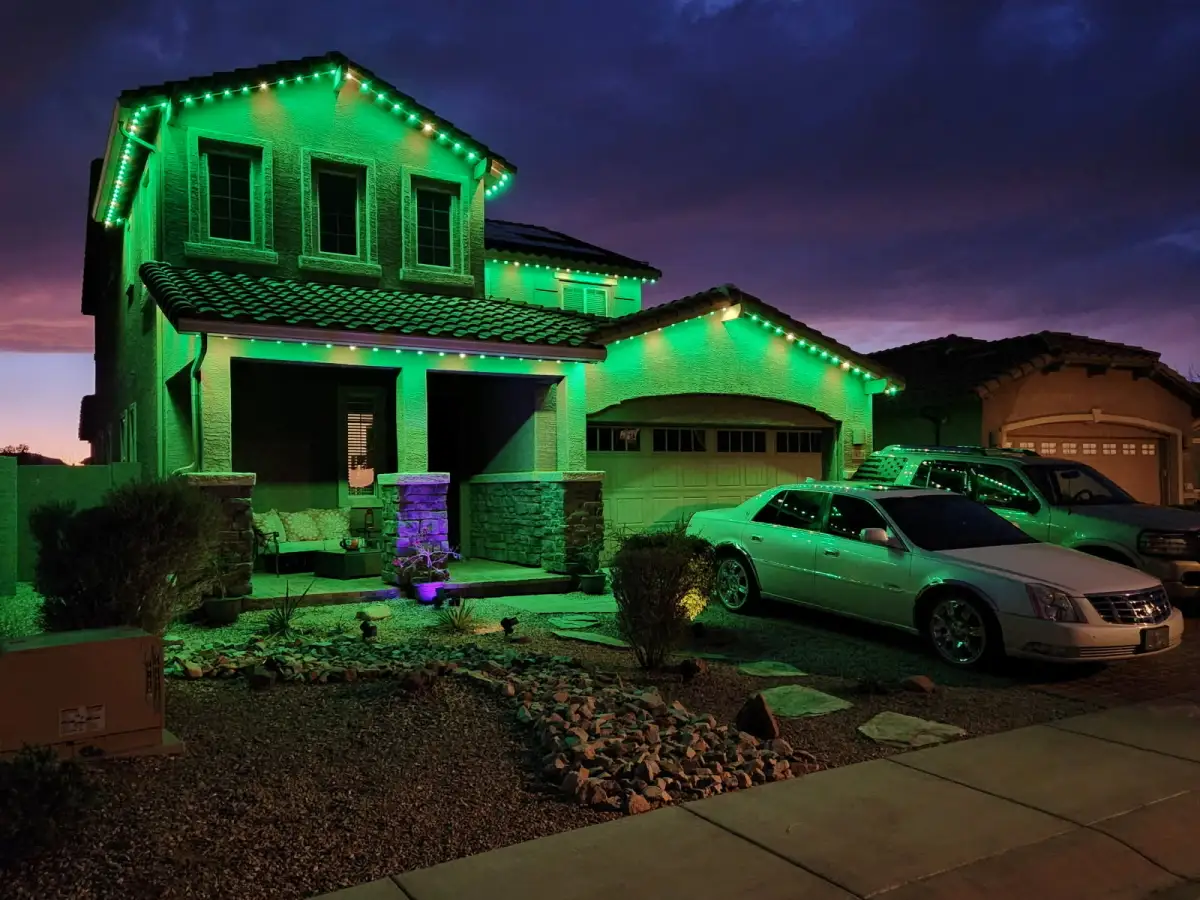
On a system with individually addressable nodes, every light holds its own color and brightness. Warm white through the fall, team colors on a Saturday, red and green through December, and back to warm white in January, all from a phone, with no ladder involved after the install.
The version of this myth that is true: if you buy a zone-only system rather than an addressable one, you really are limited to whole sections in one color. That is a specification to check before you sign, not a property of the category.
Myth 3: It only makes sense for holiday lighting
Holidays are the entry point and they are not the main use. The setting most owners run most is a soft warm white on the roofline, which is what makes the house look finished on an ordinary Tuesday in April.
The rest of the year it does the work of several separate fixtures: consistent light along dark rooflines and entries, accent zones on porch peaks and walkways, brighter settings for gatherings, and curb appeal that matters if you are thinking about listing. If the only thing you want is December, a seasonal installer is genuinely the cheaper answer.
Myth 4: It will spike your electric bill
LEDs draw a fraction of what incandescent or halogen lighting does, and the systems are scheduled rather than left running. Most owners run warm white at reduced brightness for a few hours an evening, which is a small load, and full-saturation color at maximum output, the setting people picture, is one you would only use occasionally.
Set an on and off schedule at installation and this stops being a question at all.
Myth 5: Any electrician can install it
An electrician can run wire. That is not the hard part.
The hard part is precise placement along the fascia, correct fastener spacing, sealing every penetration, and allowing for the fact that aluminium expands and contracts across a Nebraska year. A long run fastened rigidly at every point with no allowance will buckle in summer or pull at its fasteners in winter. None of that is visible from the ground, which is exactly why it is worth asking about, and why fixing a poor installation usually costs more than doing it correctly the first time.
Myth 6: It will damage your roofline or fascia
Installed correctly, no. The channel fastens to the fascia board, the vertical board behind your gutter, or to the sub-fascia behind it. Nothing goes through the shingles or the roof deck, and the drip edge is not lifted. If an installer proposes mounting through the roof surface, that is the wrong installation and you should decline it.
Where the myth comes from is real, though. The track is only as secure as what it is fastened to, and fascia is often the first thing on a house to rot because it takes runoff from every clogged gutter corner. Fastening into soft wood puts load on a board that cannot carry it. A competent installer checks the fascia before quoting and says so if it needs repair first. The whole mounting picture, including what to ask about fasteners, is in how the track actually mounts to your roofline.
And if you ever remove it, the fasteners leave holes in the fascia that fill and paint like any other fastener holes. It is not a structural alteration.
Myth 7: My HOA will never approve it
Boards hold these submissions more often than they refuse them, and the reason is usually that permanent lighting sits in a gap: holiday lights are temporary and rarely need approval, landscape lighting is well understood, and a fixture mounted to the roofline year-round is neither. Most covenants written before these systems existed do not mention them at all.
What a committee is actually deciding is what the street looks like in daylight, not what your December display looks like. Which is why the most common mistake is leading with night photographs in saturated color, and why the things that resolve most submissions are dull: a daylight photograph of your own roofline, the channel color matched to your trim, exactly which elevations are included, and the fact that nothing penetrates the roof. Volunteering your own operating limits, warm white as the default and a nightly off time, is more persuasive than being told to accept them. The full submission package is set out in what to submit to an HOA for permanent roofline lights.
Worth knowing: getting a quote is not an action your HOA needs to approve, and boards frequently meet monthly, so if lights for December are the goal, the submission timeline is the constraint rather than the install date.
The one that is not a myth
The channel is visible in daylight if you look for it. Matched to the fascia and mounted in a clean line, it reads as trim and most people stop noticing within a week. Mismatched, mounted crookedly, or with wire showing, it looks like something bolted to the house. That difference is entirely installation quality, which is why it is worth asking any installer for a daylight photograph of a finished job rather than the night shots everybody leads with.
TruLight installs permanent LED roofline lighting, metal track systems, holiday lighting, and accent zones across the Omaha metro.
Ready for an Omaha Roofline Lighting Estimate?
Call TruLight Omaha for a measured roofline estimate.
(402) 704-8151