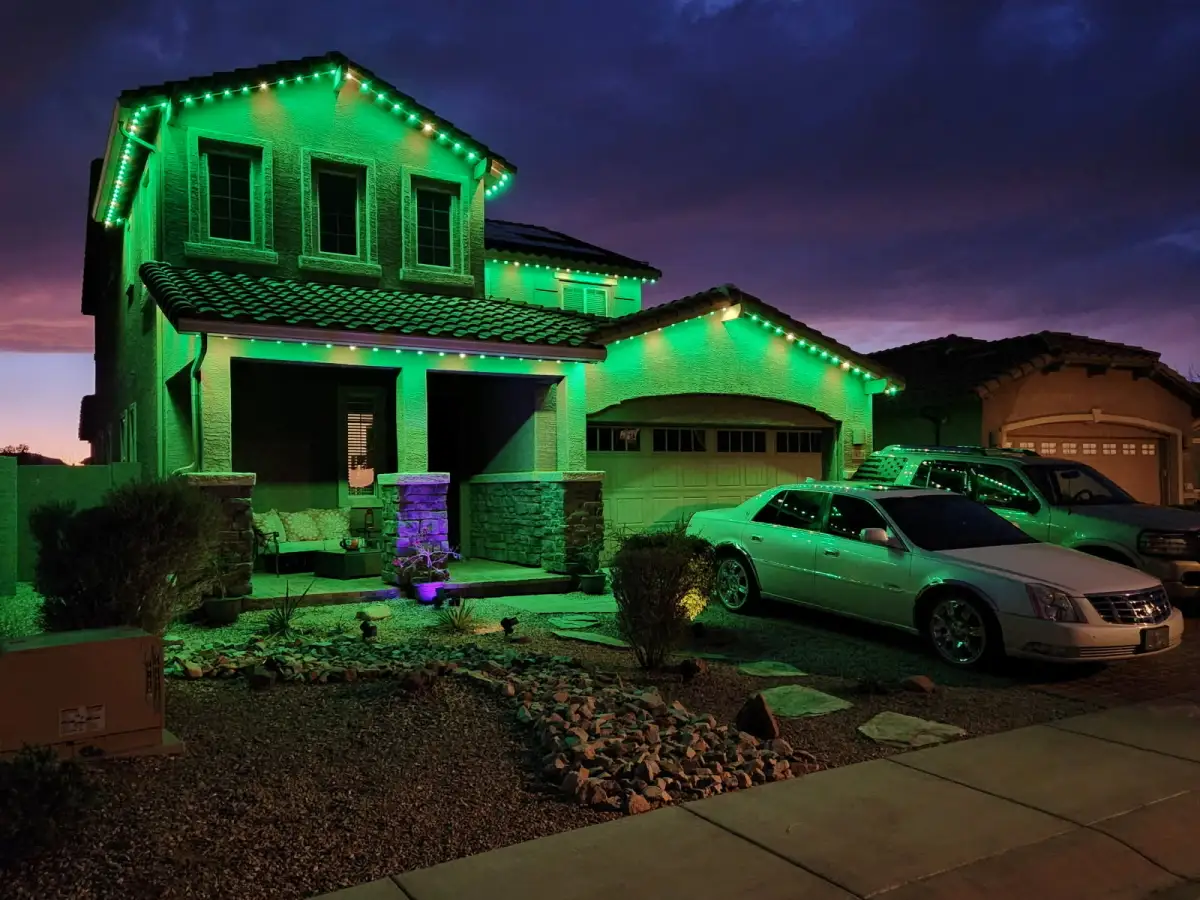
The Omaha Homeowner's Checklist for Hiring a Permanent Outdoor Lighting Company
Hiring a permanent outdoor lighting company in Omaha NE? Use this checklist to verify licensing, warranties, and support before you sign anything.
The Omaha Homeowner’s Checklist for Hiring a Permanent Outdoor Lighting Company
Permanent lighting is a fixture on your house and a service relationship that could run a decade, and the number of companies selling it in the Omaha metro has grown faster than the number of companies good at it. Most of the questions people ask on a sales call, warranty, reviews, how long it takes, get the same reassuring answer from everyone. These are the ones that do not.
Work through them in order. The first four separate installers who understand rooflines from installers who understand marketing.
1. Does anything penetrate the roof surface?
The only correct answer is no. The channel fastens to the fascia board, the vertical board behind your gutter, or in some configurations to the sub-fascia behind that. It does not go through shingles, it does not go through the roof deck, and it does not lift the drip edge.
If anyone proposes mounting through the roof surface, decline. Roof penetrations and roofing warranties are a real problem, and there is no version of this product that requires one.
2. Will you inspect the fascia before quoting, and what happens if it is soft?
The channel is only as secure as the board it is fastened to. Fascia sits directly behind the gutter taking runoff from every clogged corner, which makes it the first thing on a lot of Omaha houses to rot.
A good installer looks at it before quoting and tells you if it needs repair first. An installer who quotes off a satellite image and finds out on installation day is going to either mount into bad wood or hand you a change order while the crew stands in your driveway. Ask directly what happens if they find soft fascia, and get the answer before you sign anything. The full mounting picture is in how the track actually mounts to your roofline.
3. What color is the channel, and can I hold it against my trim?
The system is on your house in daylight for eleven months. Whether it looks like trim or looks like hardware is decided almost entirely by whether the channel color matches your fascia.
You want a physical sample held against your actual trim, in daylight, before material is ordered. A color chart is not the same thing, and changing it afterwards means re-ordering. If an installer only offers one or two finishes, that is worth knowing now.
4. How are you measuring, and what is the segment count?
Per-foot pricing is only comparable between two quotes when both are measuring the same runs. Ask which elevations are included and how many separate segments those runs break into, because every gable, dormer, porch roof, and garage return is its own run with a start, a stop, a corner, and a termination.
A quote that is meaningfully cheaper is usually cheaper because it is lighting less of the house, or lighting it with fewer nodes. That is a legitimate option, but you should be choosing it deliberately.
5. Are the nodes individually addressable, or zone-only?
Individually addressable means each node can hold its own color and brightness, which is what makes patterns, gradients, and section-by-section control possible. Zone-only means the whole front runs one color and the whole side runs another.
Zone-only systems are cheaper and they are not useless, but they are a different product, and the difference does not show up in a night photograph on a website.
6. RGB or RGBW?
RGB systems mix white from red, green, and blue, and the result is usually a muddy, faintly colored white. RGBW adds a dedicated white channel and produces a clean warm white.
This matters more than it sounds like, because warm white is the setting you will run most of the year. If the everyday look is disappointing, the system becomes a Christmas decoration you paid year-round prices for.
7. What is the IP rating on the nodes and the connections?
IP65 or IP67 is what you want for full outdoor exposure. Nebraska delivers sub-zero cold, ice, freeze-thaw cycling, driven rain, and summer heat on a south-facing elevation, and the connections fail before the LEDs do.
An installer who cannot tell you the rating of the fixtures they install has not read the spec sheet for the product they are selling you.
8. Who owns the app account, and is there a subscription?
Ask three things: whether basic control, scheduling, and scenes require a paid subscription; whether the account is in your name; and what happens when you change your router or sell the house. Also ask whether the system depends on a separate bridge device, because a bridge is one more thing that can fail and one more thing to replace.
9. If one node fails in February, what happens?
The right answer is that a single node is field-replaceable without pulling the channel. That is one of the real advantages of nodes seated in a track.
Then ask the service questions behind it: who takes the call, whether warranty service calls are free, and how long a response typically takes in Omaha in winter. A locally based crew can be there in a day or two. A national brand with no local technicians can take weeks, and February is exactly when you will find out which one you hired.
10. Licence, insurance, and warranty in writing
The baseline, and non-negotiable: a current contractor's licence, general liability insurance, and workers' compensation for anyone on your property. Ask for the documents before the site visit. A legitimate company sends them without hesitating.
On warranty, there are two and you need both in writing: the manufacturer's product warranty and the installer's warranty on labour. Ask what voids each. A product warranty that requires certified installation is only worth anything if the company installing it holds that certification.
11. Show me a daylight photograph of a finished job
Every company on earth has good night photographs. Night photographs hide crooked runs, mismatched channel color, and visible wire.
Ask for daylight shots of completed Omaha homes, taken from the street rather than as a close-up. Close-ups make the channel look enormous; from the curb a good installation reads as a trim line. Manufacturer stock images are not a substitute, because they show what the product can look like, not what this crew's work looks like once they have driven away.
What the written scope should say before you sign
Not a total and a signature line. A scope that names:
- Which elevations are included, and which are not
- How many zones, and what each one covers
- Node count and spacing
- Channel finish
- Controller location and the power connection, including any new circuit
- Whether fascia repair is included, excluded, or to be assessed
- What the app handoff includes
- Warranty terms on parts and labour
If two quotes both contain that list, you can actually compare them. If one of them does not, you are not comparing prices, you are comparing guesses.
TruLight installs permanent LED roofline lighting on low-profile metal track across the Omaha metro, and is happy to be asked every question on this page.
Ready for an Omaha Roofline Lighting Estimate?
Call TruLight Omaha for a measured roofline estimate.
(402) 704-8151