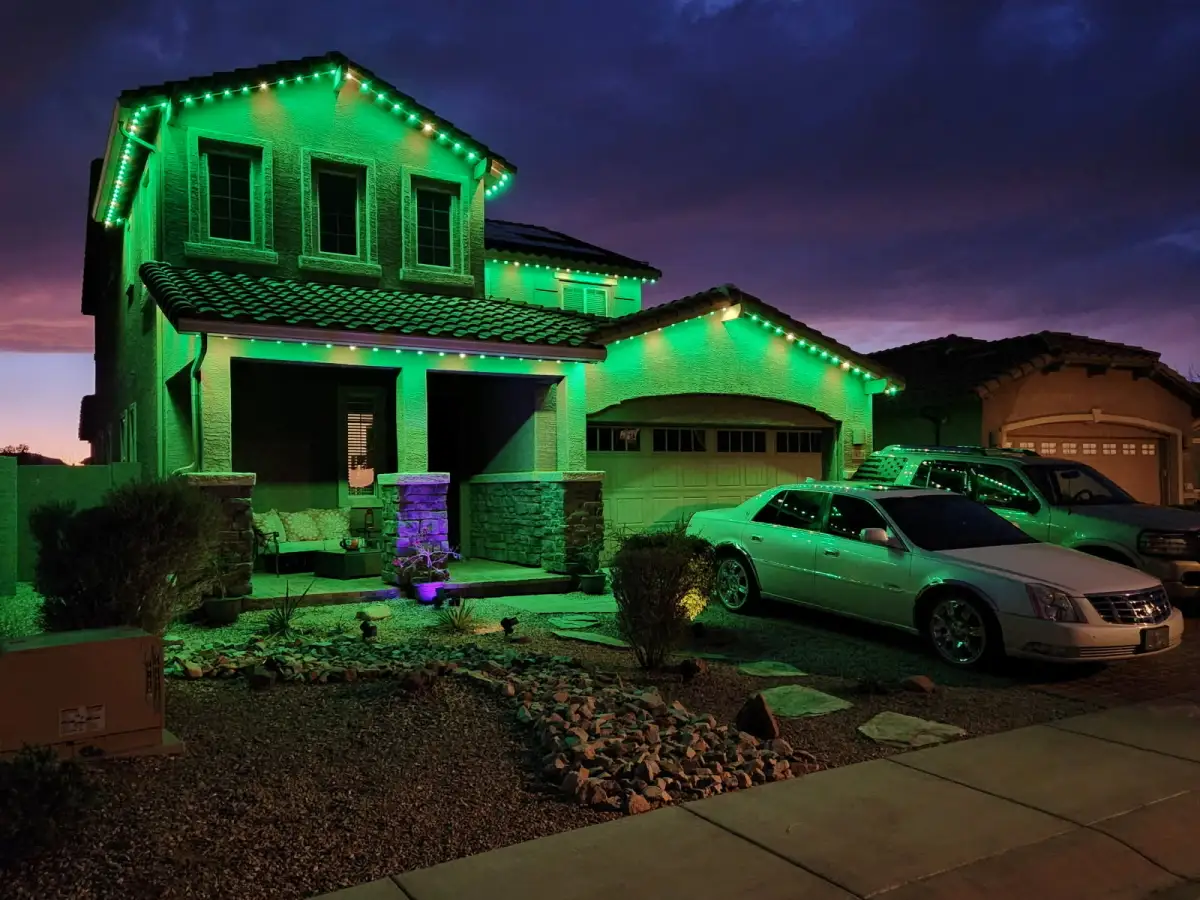
Will Permanent Lights Damage My Roofline? How the Track Actually Mounts
The track fastens to the fascia board, not through your roof. That single detail answers most of what people are actually worried about.
It is the question we get more than any other, and it deserves a real answer rather than reassurance, because a bad installation genuinely can cause problems and it is worth knowing what a good one looks like.
What is being installed
A permanent lighting system has three parts.
The channel. An extruded aluminum track, usually with a small lip or return, that runs along the roofline. The LEDs sit down inside it, recessed, which is why the system disappears in daylight and why you see light rather than bulbs at night. The channel comes in colors, and it should be matched to your fascia or trim so that during the day it reads as part of the roofline.
The lights. Individually addressable LED modules seated in the channel at regular spacing. Each one can produce its own color and brightness, which is what allows a warm white on an ordinary evening, team colors on a Saturday, and red and green in December from the same fixture.
The controller and power supply. Low voltage. A transformer converts household power down, and a controller handles the scenes and schedules, driven from an app. This is mounted somewhere sheltered, commonly in the garage, with the low-voltage run going out to the track.
Where it attaches
The channel screws into the fascia, the vertical board that runs along the roof edge behind your gutter, or in some configurations to the sub-fascia behind it. Fasteners go in at intervals along the run.
It does not go through the shingles. It does not go through the roof deck. It does not lift or disturb the drip edge. This matters because roofing warranties and roof penetrations are a real concern, and a system fastened into the fascia does not create one. If anyone proposes mounting through your roof surface, that is the wrong installation and you should decline it.
On homes without conventional fascia, and there are some, a stucco or brick edge, a parapet, certain contemporary rooflines, the mounting has to be solved differently, and that is a conversation to have during the site visit rather than on the day of installation.
What has to be sound first
Here is the honest constraint: the track is only as secure as what it is fastened to.
Fascia board is often the first thing on a house to rot, because it sits directly behind the gutter and takes the runoff from every clogged corner. If your fascia is soft, split, or already showing paint failure, it needs to be repaired or replaced before anything is mounted to it. Fastening a track to rotten wood puts a load on a board that cannot hold it, and it also means the fasteners have opened new paths into wood that is already taking on water.
A competent installer checks this before quoting and tells you if it is a problem. It is not an upsell, it is the difference between a system that stays put and one that sags in three years.
The same applies to gutters. If the gutter is pulling away or the fascia behind it is compromised, deal with that first.
The fastener question
Screws into a wood fascia, at spacing appropriate for the run and for thermal movement. Two things separate a careful installation:
Sealing. Every penetration is a hole in a painted wood board on the outside of your house. They should be sealed. It takes a moment per fastener and it is the difference between a hole that stays sealed and a hole that starts a rot spot.
Allowing for movement. Aluminum expands and contracts with temperature, and Omaha gives it a wide annual range to do it in. A long run fastened rigidly at every point with no allowance will buckle in summer or pull at its fasteners in winter. Proper installation accounts for this in how the channel is fastened and where the joints between sections fall.
Neither of these is visible from the ground, which is exactly why they are worth asking about.
Wiring and power
The run back to the transformer is low voltage, which keeps it safe and keeps the wiring modest. Where the wire goes is the part that shows, and good installations route it tight along the trim line, behind the gutter, or down a downspout so you do not see a cable across your soffit.
The transformer needs a power source. Usually that is an existing exterior outlet or a run into the garage. If a new outdoor circuit is needed, that is electrical work and should be done as such.
Winter, which is a fair question in Nebraska
The channel is aluminum and the LEDs are sealed and rated for outdoor use. Snow and ice sitting on the roofline is what the system is designed for.
Two practical notes. Ice dams that form along the eave will encase the track, and while that does not damage it, the underlying cause is worth addressing for the sake of your roof. And a gutter full of ice that pulls away from the fascia will take whatever is fastened to that fascia with it, which is another reason the condition of the roofline matters before installation.
What it looks like in daylight
This is worth being straightforward about. The channel is visible if you look for it. Matched to the fascia color and mounted in a clean line, it reads as trim, and most people stop noticing within a week. Poorly matched, mounted crookedly, or with visible wire, it looks like something bolted to the house.
The quality difference is entirely in the installation, and it is worth asking to see a completed job in daylight, not just the night photographs everyone shows.
If you ever remove it
The track comes off and the fasteners leave holes in the fascia, which fill and paint like any other fastener holes. It is not a permanent alteration to the structure of the house.
What to ask an installer
- Will you inspect the fascia before quoting, and what happens if it needs repair?
- Does anything penetrate the roof surface? The answer should be no.
- What color options do you have for the channel, and can you match my trim?
- How do you seal fastener penetrations?
- How do you handle thermal expansion on long runs?
- Where will the transformer go, and does it need a new circuit?
- What happens if a module fails in year four?
That last one is worth pressing on. LEDs last a long time and they do not last forever, and a system where a single failed module means replacing a whole run is a different purchase from one where it is a service call.
Trulight installs permanent LED lighting across the greater Omaha metro, and we look at the roofline before we quote, because what the track fastens to matters more than the lights themselves. If your fascia has seen better days, we would rather tell you that up front than mount to it.