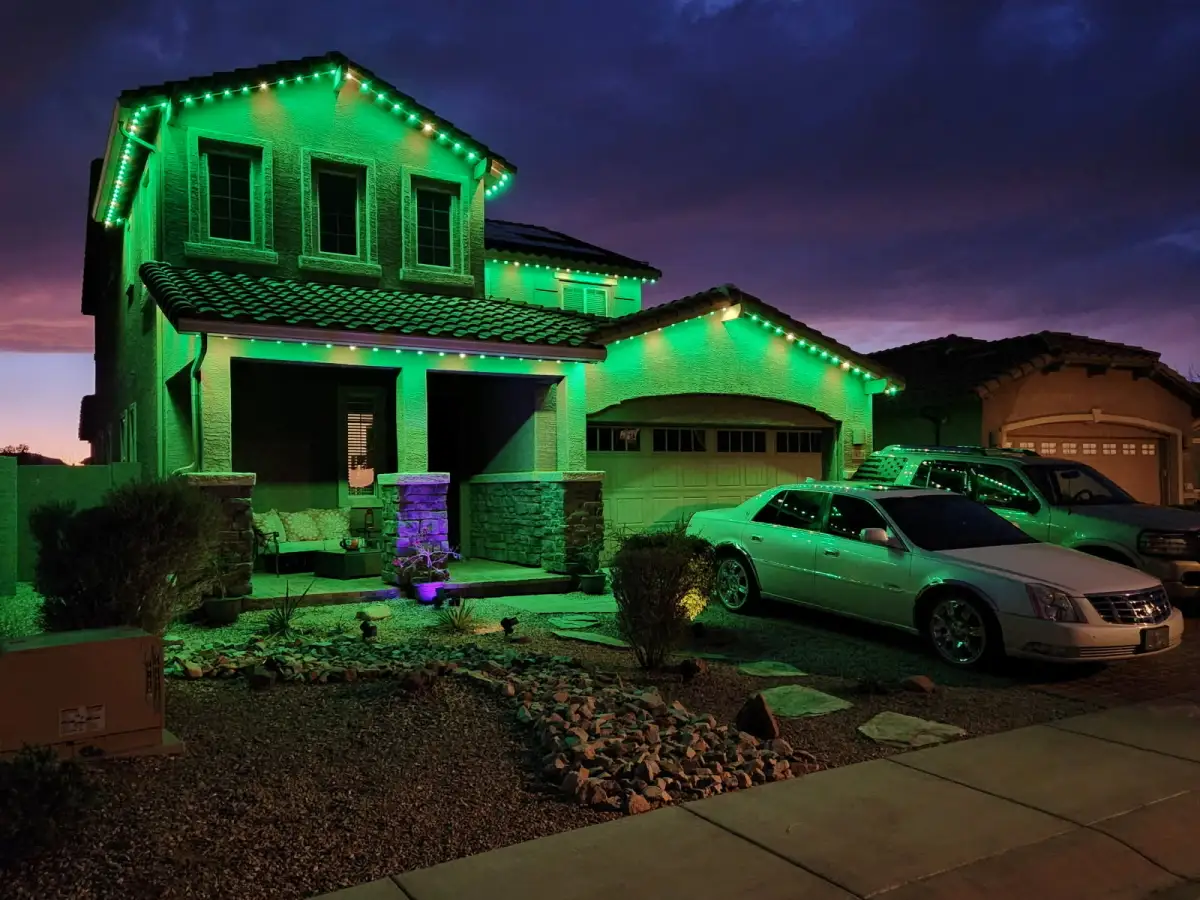
Permanent LED Lighting Papillion NE: The Year-Round Lighting Solution for Sarpy County Homes
Permanent LED lighting in Papillion NE gives homeowners a professionally installed, app-controlled system that works for every holiday and season - no
Permanent LED lighting in Papillion runs $1,500 to $2,500 for a typical single-story roofline and $2,500 to $4,500 for a two-story or a home with multiple gables, dormers and garage returns. The system is aluminum track fastened to the fascia, individually addressable LED nodes seated inside it at roughly 4 to 6 inch spacing, and a controller you drive from a phone. It is one installation, and it stays on the house.
Two things about Papillion specifically change how that job goes, and neither one gets mentioned in a generic pricing article: most of the housing stock is newer than the metro average, and a lot of it sits in covenanted subdivisions.
Newer construction means wrapped fascia
Papillion has grown fast, and a large share of its homes went up from the mid-1990s onward. On that generation of construction, the fascia is usually not bare painted wood. It is a wood sub-fascia with aluminum or vinyl coil stock wrapped over it, folded at the corners and finished to match the soffit.
That matters for the install in three ways. The fasteners have to reach the wood behind the wrap, not just bite the metal. Over-driving a screw dimples the coil stock, which is visible from the street in daylight for as long as you own the house. And the wrap hides the condition of the board underneath, so nobody knows whether the sub-fascia is sound until a fastener goes in.
The upside is that a wrapped fascia usually is sound, because the wrap has been keeping water off the wood. The older painted-wood fascia common in Bellevue and in central Omaha is far more likely to be soft behind the gutter and need repair before track goes up. This is one of the few respects in which a newer house is genuinely cheaper to light.
Gutter guards are the other newer-construction detail. Helmet-style guards sit over the drip edge and change where the channel can be fastened and how it lines up. It is solvable on almost every house, but it needs to be seen at the estimate rather than discovered on install day.
Covenants and architectural review
Newer Sarpy County developments tend to come with an active homeowners association and an architectural review process, and permanent lighting sits in an awkward spot for most of them. Holiday lights are temporary and rarely need approval. Landscape lighting is well understood. A fixture mounted to the roofline year-round is neither, and most covenants written before these systems existed do not mention them at all.
That gap is why submissions get held rather than refused. What a committee is actually deciding is what the street looks like in daylight, not what your Christmas display looks like, and a submission that leads with night photographs in saturated color is the one that gets questions. The full list of what to send, including the daylight photographs and the track color sample that resolve most of these, is here: what to submit to an HOA for permanent roofline lights.
Boards frequently meet monthly. If lights for December are the goal, starting that conversation in November is starting it too late.
What the elevation looks like here
A lot of Papillion inventory is the two-story with a projecting front gable and an attached front-facing garage. On that shape, the gable rake line is the strongest run on the house, because it is the only diagonal and it is what gives the elevation form after dark. Lighting the horizontal eave and skipping the rake produces a flat band across the front and leaves the tallest part of the house dark.
Walkout lots are common in the newer subdivisions on the west and south edges. A house that reads as one story from the street can be two and a half from the back yard, which affects both the pricing and whether you light the rear elevation at all.
Those same edges of Papillion were farmland recently enough that the trees are young. There is very little windbreak, and a roofline out there takes more wind and driven ice than one in an established neighborhood with mature canopy. That is an argument for track fastened into wood at proper spacing rather than any system that relies on adhesive clips.
Why homeowners here go permanent instead of seasonal
Falls are the honest reason, more than convenience. The Consumer Product Safety Commission tracks close to 15,000 emergency room visits a year tied to holiday decorating, and roughly half of those are falls from ladders or roofs. On a two-story with a steep pitch and a December roof, the risk is not theoretical, and it comes around every year.
The recurring cost is the second reason. Paying a crew to hang and pull seasonal strands runs about $300 to $600 a season in the Papillion area, for labor and bulb replacement, and none of that money buys anything you keep. A permanent system is a one-time installed cost. Unlike providers who quote by the season or fold installation into a subscription, TruLight's price is a single installation charge and the system is yours. Full arithmetic on both sides is in the cost comparison against traditional holiday lights.
Worth being clear about what TruLight does and does not sell: this is a permanent, year-round system installed in metal track. It is not an annual hang-and-remove service.
What actually happens on the job
The estimate is on site and takes 30 to 45 minutes. The roofline gets measured, the fascia and soffit condition gets checked, the controller location and power access get sorted, and track color gets chosen against your actual trim rather than off a chart.
Installation is usually one day. A larger house or a genuinely complicated roofline can run into a second. The track is cut to the roofline, the nodes are seated and wired back through weatherproof runs to the controller, which normally lives in the garage or another sheltered spot. The crew tests every node, cycles the colors with you watching, and sets up your first schedules before leaving.
The nodes are rated for 50,000+ hours. If a single one fails later, it gets swapped without disturbing the rest of the run.
Commercial properties in Papillion
The same track system goes on storefronts, offices and multi-family buildings, with layout planned around street visibility, entrances and signage rather than around a residential gable. That work is covered separately in permanent LED storefront lighting.
Booking
Calendars fill from September onward as the holidays get close, so spring and summer are the straightforward months to get an install date, and the system is on the house for a full run of summer evenings before December ever arrives. Hardware installation is not especially weather-dependent, but no crew is going up on an iced roof.
TruLight installs permanent LED roofline lighting on low-profile metal track throughout Papillion, La Vista, Bellevue and the rest of Sarpy County. Call (402) 704-8151 or request a free estimate.
Ready for an Omaha Roofline Lighting Estimate?
Call TruLight Omaha for a measured roofline estimate.
(402) 704-8151