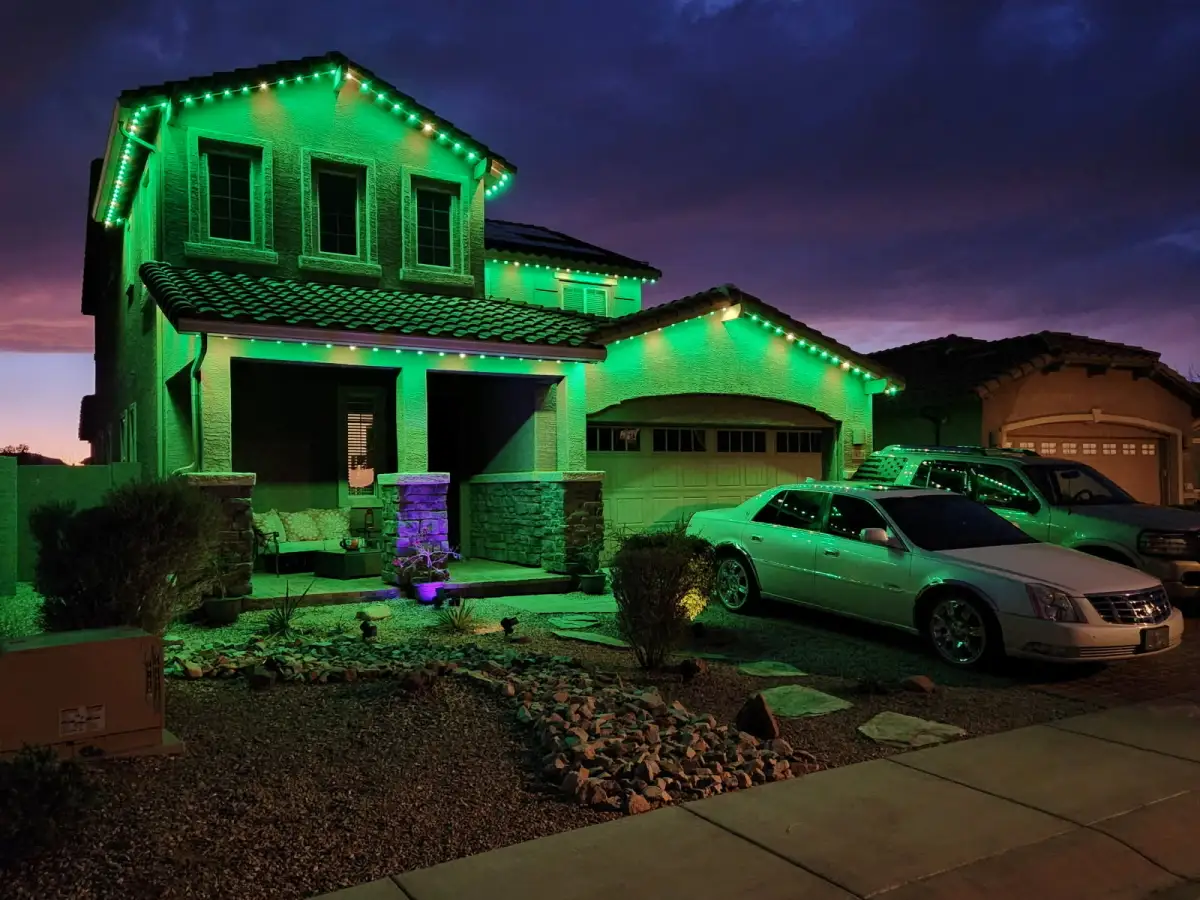
From Consultation to First Light: The Permanent Outdoor Lighting Installation Process in Omaha
Trulight Omaha walks you through the permanent outdoor lighting omaha ne installation process, from consultation to first light. See what to expect.
From Consultation to First Light: The Permanent Outdoor Lighting Installation Process in Omaha
Most of a permanent lighting installation is decided before anyone arrives with a ladder. The physical work is usually a single day; what determines whether the finished job looks like trim or looks like something bolted to the house happens at the site visit and on the design. Here is the whole sequence, and specifically the parts where something can go wrong.
The site visit: what is being measured and checked
It takes half an hour to forty-five minutes on a typical Omaha home, and five things get established.
The measured roofline. Not the perimeter of the house. The actual runs you decide to light, segment by segment. Every gable, dormer, porch roof, and garage return is its own run with a start, a stop, a corner, and a termination, and segment count drives the price far more than square footage does.
Fascia and soffit condition. This is the one that matters most and the one most often skipped. The channel is only as secure as the board it is fastened to, and fascia sits directly behind the gutter taking runoff from every clogged corner, which makes it the first thing on many Omaha houses to go soft. If it is split, spongy, or already failing its paint, it needs repair before anything is mounted. Fastening into rotted wood puts load on a board that cannot hold it and opens new water paths into wood that was already wet.
On newer construction, the fascia is usually wrapped in aluminium or vinyl coil stock over a wood sub-fascia. That is generally good news, because the wrap has been keeping water off the board, but it hides the condition underneath and it means fasteners have to reach the wood rather than just biting the metal.
Gutter guards and the drip edge. Helmet-style guards sit over the drip edge and change where the channel can be fastened and how it lines up. Almost always solvable, but it needs to be seen now rather than discovered on installation day.
Power and controller location. The controller wants a sheltered spot, commonly the garage, with a run out to the track. If there is a usable exterior circuit near it, straightforward. If a dedicated circuit is needed, that is electrical work and it belongs on the quote as a line item, not as a surprise.
Channel color against your actual trim. Held up against the fascia in daylight, not chosen off a chart. This single decision does more for how the system looks during the day than anything else, and changing it after the fact means re-ordering material.
The design: zones, not one long run
A permanent system is not one circuit from corner to corner. It is divided into zones, and how it is divided decides how usable it will be.
The practical test is whether you can run one part of the house without the rest. A front roofline on every evening while the patio stays dark. An upper elevation on a scene while the entry stays warm white. A rear elevation that only comes on when you are out there. If those are all one zone, the system gets used for the first holiday and then sits on a single setting, because every change is all-or-nothing.
You should see where the channel runs, where each zone begins and ends, and where the controller goes before any hardware is ordered. Adjustments are free at this stage and expensive afterwards.
Installation day
One day for most Omaha homes, typically four to eight hours depending on size and roofline complexity. Larger homes or genuinely complicated rooflines run into a second.
- Channel goes up. Aluminium track cut to the roofline and fastened into the fascia or soffit with stainless steel fasteners at spacing appropriate to the run. Nothing goes through the shingles or the roof deck. If anyone proposes mounting through the roof surface, that is the wrong installation.
- Penetrations get sealed. Every fastener is a hole in a board on the outside of your house. Sealing them takes a moment each and is the difference between a hole that stays sealed and one that starts a rot spot. It is invisible from the ground, which is exactly why it is worth asking about.
- Movement gets allowed for. Aluminium expands and contracts, and Omaha gives it a wide annual range to do it in. A long run fastened rigidly at every point with no allowance will buckle in summer or pull at its fasteners in winter. It is handled in fastener spacing and in where the joints between sections fall.
- Nodes are seated and wired. Individually addressable LED modules go into the channel at regular spacing, with low-voltage wiring routed tight along the trim line, behind the gutter, or down a downspout so there is no cable visible across the soffit.
- Everything is tested. Every node, before anyone packs up. A dead node found on the day is a two-minute fix; found in December it is a service call.
The work is exterior, so there is no disruption inside the house, and the site is cleared before the crew leaves.
The walkthrough
This is the part people skip and then regret. Before the crew goes, the app is installed on your phone, the controller is paired, and the zones are named in language that means something on your house rather than "Zone 1" and "Zone 2."
What you should leave the walkthrough able to do without help: save a warm white scene, adjust brightness, set a schedule with an on and off time, switch to a holiday scene, and add a second user so you are not the only person in the house who can turn the lights on. Most people are comfortable inside fifteen minutes.
Building your first few scenes then, in daylight, while someone is standing there, is worth doing even if you are not in the mood. The alternative is discovering in the first week of December that the Christmas scene was never saved.
The first year
Maintenance is minimal by design. There is no seasonal removal, no storage, and no re-hanging. Two things are worth knowing anyway.
A single failed node shows up as a dark spot in the run and is field-replaceable without pulling the channel. That is a real advantage of nodes in a track over a sealed strand, where one failure can take a whole run.
And ice dams along the eave will encase the track. That does not damage it, but the underlying cause is worth addressing for the sake of the roof, and a gutter full of ice that pulls away from the fascia will take whatever is fastened to that fascia with it. Which is, again, why the condition of the roofline before installation is the thing that decides how the system ages.
The mounting detail behind all of this, including what to ask an installer about fasteners and roof penetrations, is in how the track actually mounts to your roofline. TruLight installs permanent LED roofline lighting on low-profile metal track throughout the greater Omaha metro.
Ready for an Omaha Roofline Lighting Estimate?
Call TruLight Omaha for a measured roofline estimate.
(402) 704-8151