How to Choose the Right Permanent Outdoor Lighting System for Your Omaha Home
Not sure which permanent outdoor lighting Omaha NE homeowners trust most? This guide covers every decision, from style to system type.
How to Choose the Right Permanent Outdoor Lighting System for Your Omaha Home
Choosing a permanent lighting system comes down to six specifications and one look at your own roofline. Everything else is preference. This page covers the specifications, because they are the part that is hard to change later and the part almost no sales conversation gets into.
If you are evaluating the *company* rather than the product, that is a different list: use the checklist for hiring a permanent lighting company.
Channel profile and finish
The channel is an extruded aluminium track, roughly an inch wide, with a lip or return that the LEDs sit down inside. That recess is the whole reason a permanent system disappears in daylight and the reason you see light at night rather than bulbs.
Two things to decide. Finish, which should be matched to your fascia or trim so that during the day the run reads as a trim line. Get a physical sample against your own trim in daylight, because this is the single decision that most determines how the system looks for eleven months of the year. And profile depth, because a deeper recess hides the nodes better from below but narrows the spread of light at the ends of a run.
Ask about the temperature range the material is rated for. Omaha delivers sub-zero winters and hot south-facing elevations in July, and aluminium moves across that range. A long run fastened rigidly with no allowance for movement will buckle in summer or pull at its fasteners in winter.
Addressable nodes versus zone-only
This is the biggest functional split in the category.
Individually addressable means every node holds its own color and brightness. That is what makes gradients, patterns, section-by-section control, and any effect more interesting than "the whole front is red" possible.
Zone-only means the front runs one color and the side runs another, full stop. It costs less, and for a homeowner who only wants warm white plus a red-and-green setting in December, it is not a bad buy. But it is a different product, and the difference is invisible in the night photographs on everyone's website. Ask outright.
RGB versus RGBW
An RGB node mixes white out of red, green, and blue. The result is a white with a color cast in it, usually slightly cold and slightly muddy.
An RGBW node adds a dedicated white diode, and the difference in the warm white setting is obvious side by side. This matters more than it sounds like, because warm white is what the system runs most of the year. A system whose everyday setting looks off becomes a Christmas decoration you paid year-round prices for.
Color temperature and brightness
For everyday use, most Omaha homeowners run warm white in the 2700K to 3000K range, which reads as soft and welcoming, or cool white at 4000K to 5000K, which reads crisp and modern. Warm white generally suits brick, stone, and earth-toned siding; cool white suits grey, white, and black-trimmed contemporary exteriors. Look at your own house at dusk before deciding, because the siding color does more to the result than the setting does.
Output matters more than people expect. A system topping out around 50 lumens per foot is fine for accent work and underwhelming along a roofline where it competes with a streetlight. Quality systems run 100 lumens per foot or higher at full brightness. Ask for the number rather than an adjective.
More brightness is not automatically better. Saturated color at full output is harsher than white at the same setting, and full brightness across a long low roofline flattens a house rather than shaping it. What you want is headroom you can dial down, not a system you have to run at maximum to be visible.
Weather rating
IP65 or IP67 on both the nodes and the connections. The connections are what fail first in this climate, not the diodes: freeze-thaw cycling, driven rain, and ice sitting on the eave all work on the joints.
Any system sold nationally is not automatically tested for a Nebraska annual range. Ask for the rated temperature range in writing.
Controller, app, and what you actually own
The hardware is only as good as the thing driving it. Five questions:
- Does basic control, scheduling, and scene saving require a paid subscription?
- Is the account in your name, and does it transfer if you sell the house?
- Does the system depend on a separate bridge device? That is one more thing to fail and replace.
- What happens when you change your router?
- Can zones be controlled independently, and can a second person in the household have access?
Scheduling is the feature that decides whether a system gets used. A setup where the lights come on at dusk and off at a set hour, with holiday scenes queued months ahead, is one you enjoy. A setup where every change is a manual job on your phone is one that ends up permanently on warm white.
Then look at your own roofline
The specifications above are the same on any house. What changes is how much of that capability you need.
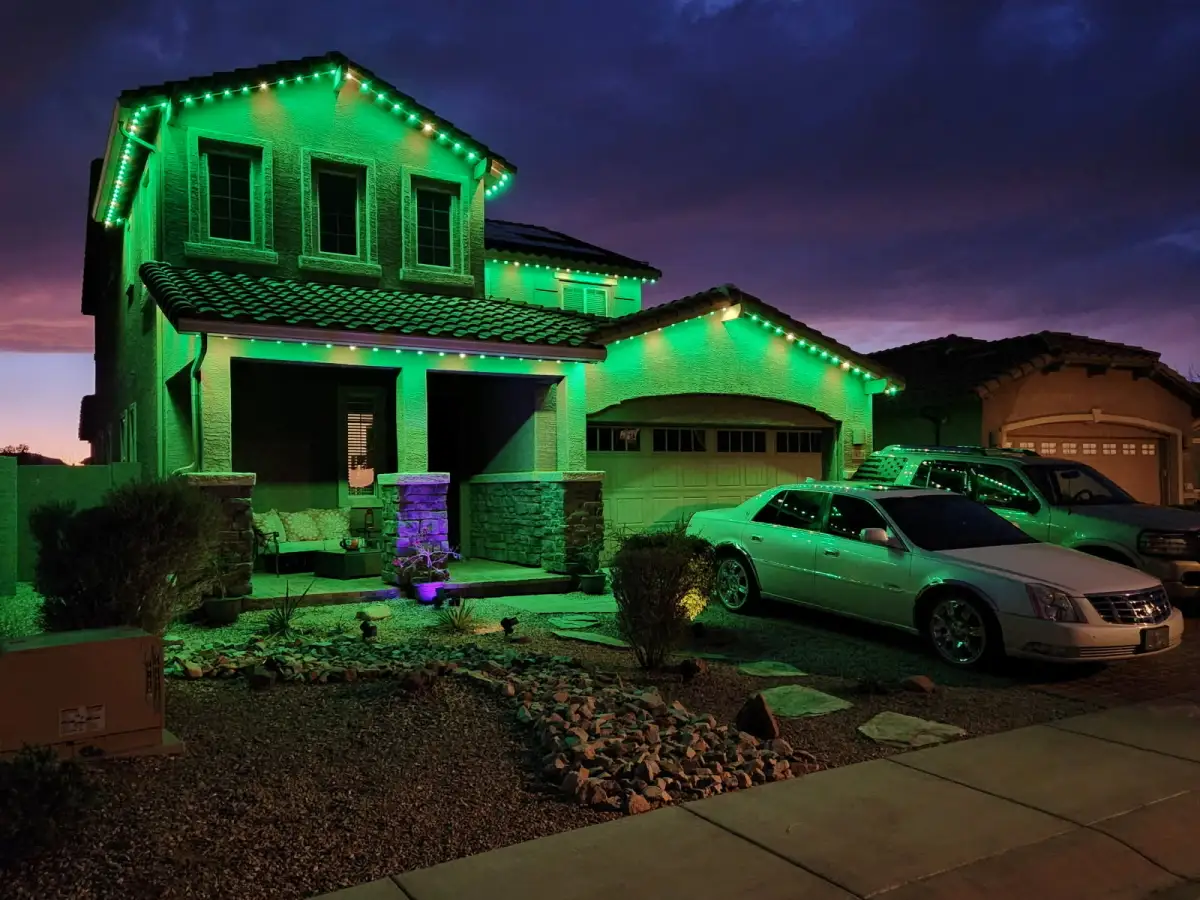
Zones are the real decision. A permanent system is not one run corner to corner. The roofline zone defines the shape of the house at night and is where most of the budget goes. Fascia and lower-elevation runs add depth on a two-story where the main roofline does not reach the garage or the entry. Accent zones pick out columns, porch peaks, patio edges, walkways, and landscape features. A single-story ranch often gets its full effect from the roofline plus one accent zone; a two-story with multiple gables benefits from all three working separately.
Architecture narrows it further. A craftsman with wide overhangs and exposed trim wants a low-profile channel that sits flush and disappears. A two-story with a projecting front gable needs the rake line lit, because the diagonal is what gives the elevation form after dark and lighting only the horizontal eave leaves the tallest part of the house dark. A straightforward ranch roofline makes for a clean, fast install and rewards restraint over capability.
Walk the house at dusk before you talk to anyone. Note where shadows fall, where the garage sits relative to the entry, and whether trees or landscaping already create focal points. Those observations tell an installer more about where zones should start and stop than any preference you can describe in the abstract.
TruLight installs permanent LED roofline lighting using low-profile metal track and accent zones across the Omaha metro, and will walk the specification list above against your own house before quoting it.
Ready for an Omaha Roofline Lighting Estimate?
Call TruLight Omaha for a measured roofline estimate.
(402) 704-8151