Permanent Christmas Lights Omaha NE: Cost, Brands & Reviews
Choosing permanent Christmas lights for your Omaha home? Learn what features matter, which brands to consider, and how to find the right installer.
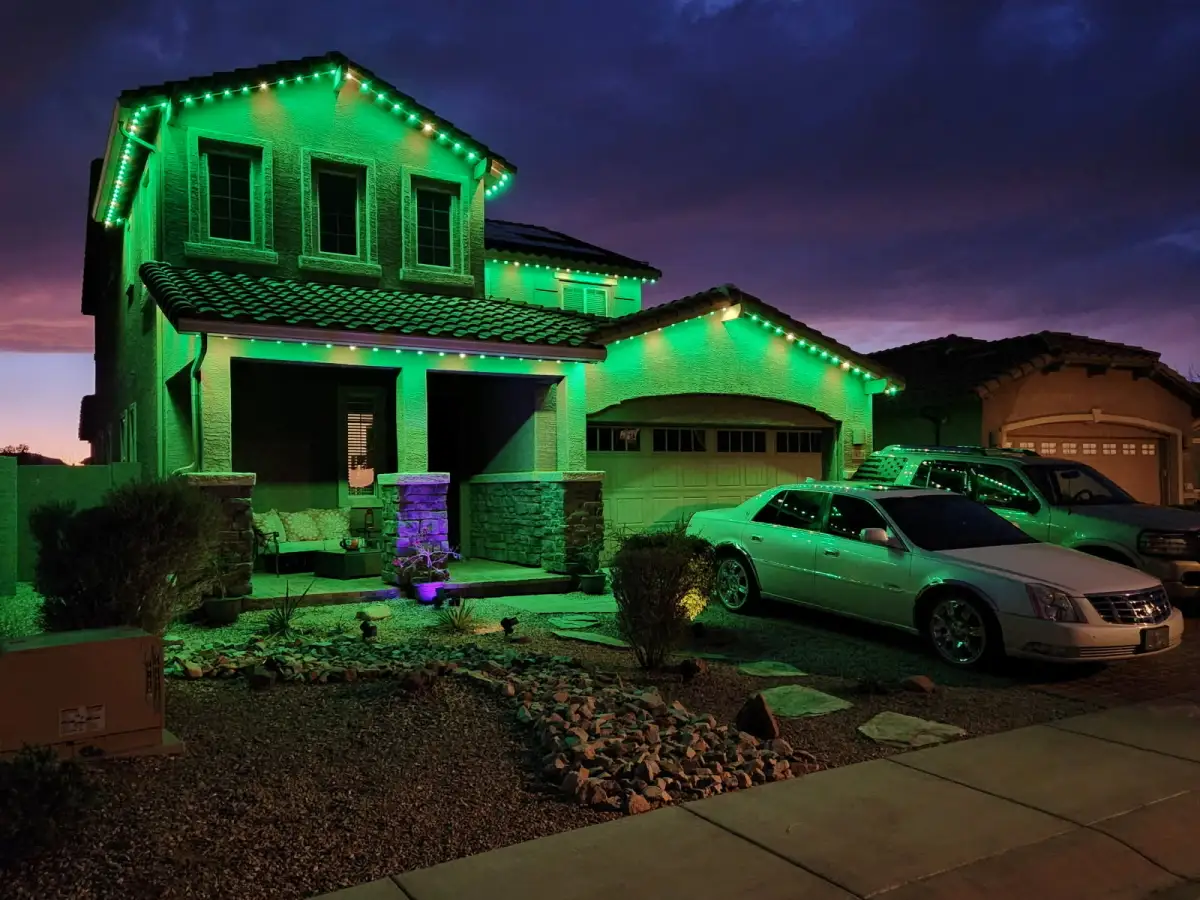
Every permanent Christmas light system sold in Omaha is built from the same four parts: an aluminum channel fastened to the fascia, low-voltage LED nodes seated inside it, a transformer, and a controller you drive from a phone app. The differences that actually show up on your house are narrower than the sales material suggests. They come down to how the system makes white, how far apart the nodes sit, whether the schedule survives a router reboot, and who did the mounting. For a full roofline on most Omaha-area homes, installed price runs $1,500 to $4,500.
Here is what separates one system from another, in roughly the order it will matter to you.
The white is the difference you will actually see
You will run this system white for most of its life. Christmas is a few weeks. Warm white on the roofline is the other eleven months, which means the quality of the white is the first thing worth asking about and the last thing anyone demonstrates.
Cheaper nodes are RGB only. White gets mixed from a red, a green and a blue diode firing together, and mixed white is never quite neutral. It leans blue, or pink, or faintly green, and the lean is not identical from one node to the next, so a long run reads as a slightly uneven line instead of a clean one. It photographs worse than it looks in person, which matters the day you list the house.
Better nodes are RGB+W, with a fourth diode that produces white on its own. That diode has a fixed color temperature, and something in the 2700K to 3000K range is what reads as a lit home rather than a lit parking lot. Every system's color demo looks impressive. The white is where they separate.
Node spacing decides whether you see a line or a row of dots
Nodes sit inside the channel at regular spacing, typically every 4 to 6 inches. That gap is the whole difference between a roofline that reads as a continuous lit edge from the street and one that reads as a string of points. At four inches, a two-story elevation seen from the sidewalk looks close to continuous. At six, you can count the nodes. Some people prefer visible points for holiday color. Almost nobody prefers them for everyday white.
The channel plays into this too. A channel with a diffusing lens softens the points. An open channel with bare nodes does not.
Long rooflines lose voltage, and that is where cheap installs show
This is the failure that never comes up in a sales call. Low-voltage runs drop voltage over distance. Feed a 200 foot roofline from a single point and the far end goes dim, and because the color channels fall off unevenly, the far end also shifts color. Clean white above the garage, faintly amber at the far gable.
The fix is routine and every competent installer knows it: inject power at more than one point along the run, or split the roofline into separately fed zones. It costs a little more wire and a little more labor. It is also one of the most common reasons a system that looked right on day one looks wrong two elevations over.
Where the schedule lives
Every one of these systems connects to an app. What differs is whether the controller is holding your schedule itself or asking a server for it each evening. A controller that stores schedules locally keeps turning the lights on at dusk when the internet is down or the router has been swapped out. A cloud-dependent one may not, and this metro loses power and service to storms often enough that the distinction is practical rather than theoretical. Most of these controllers also join 2.4GHz networks only, which trips up mesh setups that publish one network name across both bands.
Track, and the temperatures it has to survive
The channel is extruded aluminum on any system worth installing. Plastic channel goes brittle in cold and will not hold a straight line across a long run. Profile matters as much as material: TruLight's track is roughly an inch wide, powder-coated to match your fascia or trim, so during the day it reads as a trim line rather than as equipment. From the curb you have to look for it.
Sealing has to cover the swing this climate actually delivers, which runs to roughly -20°F in a hard winter and past 120°F on a south-facing fascia in July. The aluminum track TruLight installs is rated from -40F to 150F and fastened with stainless steel hardware.
Brands, and the thing that outranks them
Several national permanent-lighting lines are sold across the Omaha metro, almost always through local dealers who carry exactly one of them. Comparing badges is close to the least useful way to spend an afternoon, because two competing dealers will quote you the same four components at similar money. What separates the quotes is the spec inside those components and the work done on the ladder.
Mounting is what decides whether the system is still straight in five years. The channel screws into the fascia board, never through the shingles, and it is only as secure as the board behind it. Fascia is usually the first wood on a house to rot, because it sits directly behind the gutter and takes the runoff from every clogged corner. Soft or split fascia has to be repaired before anything is fastened to it, and a good installer tells you that before quoting rather than after. The full mounting detail, including what happens on stucco, brick and parapet edges, is written up here: how the track actually mounts to your roofline.
What reviews of permanent lighting actually complain about
Read enough of them across the industry and the same handful of problems come up. None of them are about color.
- A run sagged or pulled loose at a corner, which is a fastener spacing problem or a fascia problem.
- The controller stopped honoring its schedule after a router change.
- A replacement node came from a later production batch and does not match the color of the rest of the run.
- The dealer stopped answering the phone after the install, so one dead node turned into a year-long annoyance.
The last one is the reason to care whether the company that sells you the system is the company that will pick up in February. TruLight is Omaha-based, and the crew that measures the roofline is the crew that installs it. The company holds a 5.0 rating from 25+ Google reviews.
What it costs here
Most single-story homes in the Omaha area run $1,500 to $2,500 for a full roofline. Two-story homes typically fall between $2,500 and $4,500 depending on linear footage and roofline complexity. The variables are footage, story count, the number of gables and returns, how many separately controlled zones you want, and whether the fascia needs work first. Pricing broken out by roofline length is in the Omaha cost guide.
Quality LED nodes are rated for 50,000+ hours, which at six hours a night is 20+ years. The aluminum channel outlasts the diodes.
When to book
Calendars start filling in September, when people work out how close December is. Spring and late summer are the easy months to get the date you want, and a system installed in April spends a whole summer doing warm white on the roofline before it ever does anything for Christmas. Installing during the November and December rush is possible, but it is the worst time to ask for a specific date, and no crew is going up on an iced roof.
If you are still deciding between a permanent system and paying someone to hang and pull strands every year, both sides of that are covered in permanent holiday lights in Nebraska and what to know before you hire someone to hang your Christmas lights.
TruLight installs permanent LED roofline lighting across the Omaha metro on low-profile metal track cut on site and finished to match your trim. The estimate is free and it happens at the house, because the only honest number for this work comes from measuring the actual roofline. Call (402) 704-8151.
Related Articles
Permanent Outdoor Lighting vs. Traditional Holiday Lights in Omaha: Which Wins?
Permanent Christmas Lights Cost in Omaha, NE: 2026 Pricing Guide
Permanent Christmas lights in Omaha usually cost $1,500 to $4,500 for most homes. See price ranges by roofline length, story count, track type, and holiday-light savings.
How Much Does Permanent LED Lighting Cost in Omaha, NE? (2026 Pricing Guide)
Permanent LED lighting cost in Omaha ranges from $1,500 to $4,500 for most homes. This guide breaks down pricing by roofline length, system type, and what's included in a professional install.
Ready for an Omaha Roofline Lighting Estimate?
Call TruLight Omaha for a measured roofline estimate.
(402) 704-8151