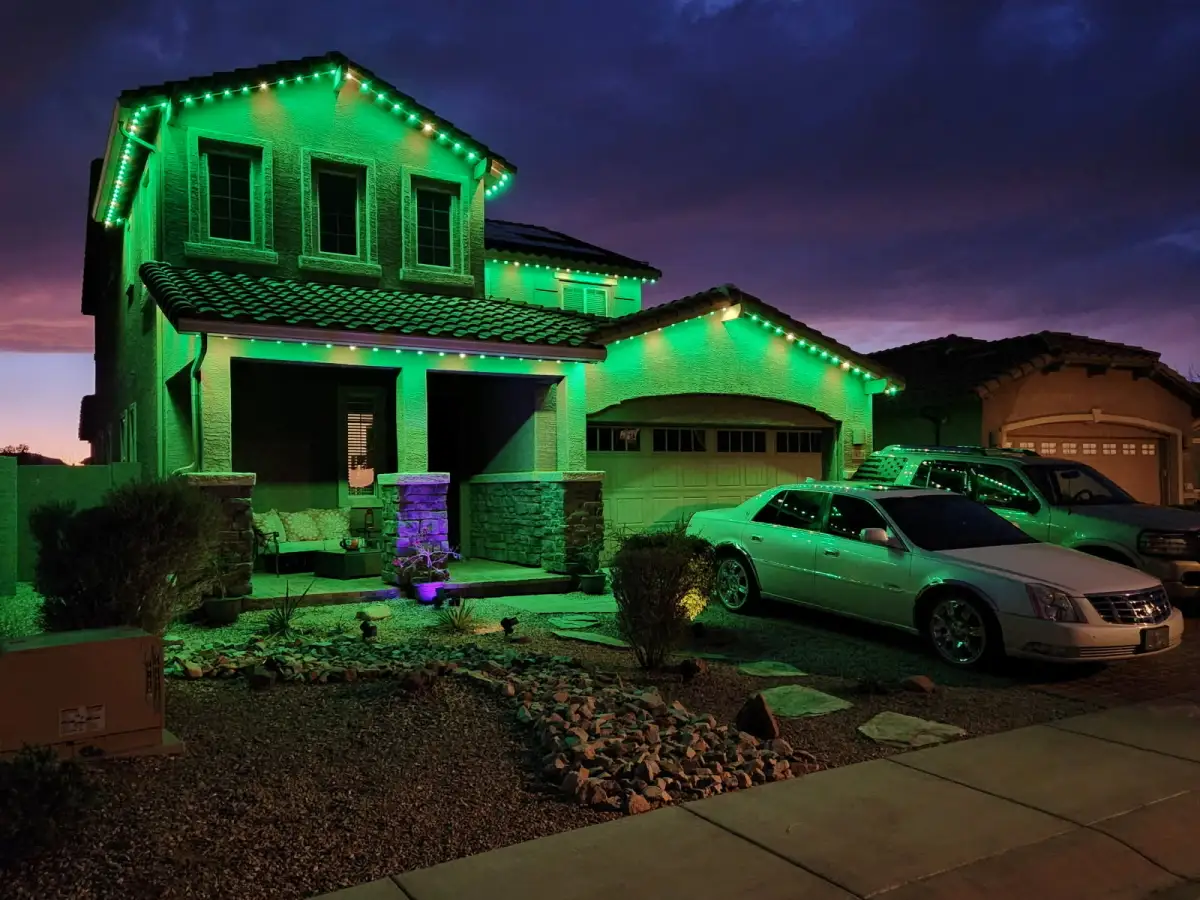
Permanent Christmas Lights in Gretna, NE: What Homeowners Should Know Before Installing
Thinking about permanent Christmas lights for your Gretna, NE home? Learn about installation costs, how the systems work, what makes them different
Permanent Christmas Lights in Gretna, NE: What Homeowners Should Know Before Installing
Permanent Christmas lights are the fastest-growing lighting upgrade we install in the Gretna area, and the question almost every homeowner opens with is what it will cost on their house specifically. That answer is decided by the roofline, not by the town, so the most useful thing this page can do is explain which house lands in which band and why.
What you are actually buying
Individually addressable LED nodes seated in an aluminum channel that is cut to your roofline and fastened to the fascia or soffit. The channel is finished to match your trim, so during the day it reads as a trim line rather than as a fixture. Low-voltage wiring runs back to a controller in a sheltered spot, usually the garage, and everything after that happens from a phone.
The word "Christmas" undersells it. Once the hardware is up, red and green in December is one saved scene among many: red, white, and blue in July, orange and purple in October, Husker red on a Saturday, and a soft warm white on the roofline for the ordinary evenings that make up most of the year. That last setting is the one most homeowners end up running the most.
It is not an annual hang-and-remove service. The system goes up once and stays.
Cost by scope, and which house lands where
| Scope | Installed cost |
|---|---|
| Small home, front roofline only | $1,500-$2,500 |
| Average home, full front and sides | $2,500-$4,500 |
| Larger or custom home, full perimeter | $4,500-$8,000+ |
| Landscape and accent zones added | $800-$2,500 additional |
Most Gretna homes land in the first two rows. What moves a house from one to the next is rarely square footage:
- Segment count, not perimeter. Every gable, dormer, porch roof, and garage return is a separate run with its own start, stop, corner, and termination. A long straight eave and the same footage broken into seven segments are not the same job.
- Story count. A second story is access, and access is time.
- Which elevations you light. Front only is a genuine option and a common one. Front and both sides is the usual upgrade. Full perimeter is what puts a house into the top row, and on a walkout lot it means a rear elevation that reads as two and a half stories from the back yard.
- Electrical. If there is a usable exterior circuit near where the controller should live, that is straightforward. If a new outdoor circuit is needed, that is electrical work and it belongs on the quote as its own line.
- Fascia condition. Soft or split fascia has to be repaired before anything is fastened to it. It is not an upsell, it is the difference between a channel that stays put and one that sags in three years.
Accent zones for columns, walkways, and landscape beds are priced separately because they are a separate decision. Plenty of homeowners do the roofline first and add accent lighting later on the same controller.
What should be on the quote
A quote that says "full installation" and a number tells you nothing you can compare. What you want itemised:
- Hardware: channel, LED nodes, controller, and power supply, named
- Which elevations are included, and how many zones they are split into
- Electrical connection and weatherproofing
- App setup and a walkthrough before the crew leaves
- Warranty on parts and on labour, in writing, with what voids each
Be careful with quotes that split "hardware" from "installation" in a way that obscures the total, and with per-foot numbers that do not say what hardware that foot includes. Per-foot pricing is only comparable between two installers when both are measuring the same runs with the same nodes in them.
The break-even against paying someone every year
Professional hang-and-remove service in the Omaha metro commonly runs $300-$800 a year. That is not a purchase, it is a subscription: none of it is still yours in February, and it comes around every November whether or not you enjoyed the last one.
Most homeowners who switch recoup the installation cost within three to five years once you count the seasonal service, the strands replaced along the way, and the lower draw of an LED system. After that the running cost is essentially electricity. The arithmetic gets better the taller the house is, because a two-story is exactly the roofline a seasonal crew charges the most to work on.
Newer Gretna subdivisions: two things to check first
A large share of Gretna's housing stock is recent, which changes the job in two specific ways.
The fascia is probably wrapped. On newer construction the fascia is usually a wood sub-fascia with aluminium or vinyl coil stock folded over it. Fasteners have to reach the wood behind the wrap rather than just biting the metal, and over-driving one dimples the coil stock in a way you will see from the street in daylight for as long as you own the house. The upside is that a wrapped board is usually sound, because the wrap has been keeping water off it.
There is probably an architectural review committee. Permanent lighting sits awkwardly in most covenants: holiday lights are temporary and rarely need approval, landscape lighting is well understood, and a fixture mounted to the roofline year-round is neither. Most covenants written before these systems existed do not mention them at all, which is why submissions get held rather than refused. What the committee is actually deciding is what the street looks like in daylight, so a submission that leads with night photographs in saturated color is the one that gets questions. The full package that resolves most of these, including the daylight photographs and the channel color sample, is set out in what to submit to an HOA for permanent roofline lights.
Boards frequently meet monthly. If December is the goal, starting that conversation in November has already failed.
Timing
Calendars fill from September onward as the holidays approach, and installation is not weather-proof: no crew is going up on an iced roof. Late summer and early fall are the straightforward months to get a date, and booking then means the system is live for game days and Halloween before December ever arrives.
The site visit is where the real number comes from. The roofline gets measured, the fascia and soffit get checked, the controller location and power access get sorted, and the channel color gets chosen against your actual trim rather than off a chart.
TruLight installs permanent LED roofline lighting on low-profile metal channel throughout Gretna, Papillion, La Vista, Bellevue, and the rest of Sarpy and Douglas counties.
Related Articles
How Much Does Permanent LED Lighting Cost in Omaha, NE? (2026 Pricing Guide)
Permanent LED lighting cost in Omaha ranges from $1,500 to $4,500 for most homes. This guide breaks down pricing by roofline length, system type, and what's included in a professional install.
Permanent Christmas Lights Cost in Omaha, NE: 2026 Pricing Guide
Permanent Christmas lights in Omaha usually cost $1,500 to $4,500 for most homes. See price ranges by roofline length, story count, track type, and holiday-light savings.
Outdoor Lighting Ideas for Omaha Homes: A Complete Guide to Year-Round Curb Appeal
Permanent roofline LED, landscape pathway lighting, deck and patio lighting - a complete guide to outdoor lighting for Omaha homes built to handle Nebraska weather.
Ready for an Omaha Roofline Lighting Estimate?
Call TruLight Omaha for a measured roofline estimate.
(402) 704-8151