Holiday Lighting Ideas for Omaha Homes: Year-Round Inspiration
Discover creative holiday lighting ideas for your Omaha home. From Christmas classics to game day displays, see how permanent LED lighting transforms
A permanent system will do millions of colors, and that is exactly the trap. The displays that look expensive from the street are almost always the restrained ones: two colors, one pattern, held steady. The ones that look cheap are the ones using everything the app can do at once.
So this is less a list of colors than a set of rules for making a permanent roofline system look deliberate, plus the palettes that actually work on Omaha houses.
Five rules that do most of the work
Two colors, not five. Alternating red and green reads as Christmas from a hundred feet. Red, green, gold, blue, and white on the same run reads as noise. If you want more than two, put the third color on a different zone rather than mixing it into the same run.
Alternate on a period, not per node. Switching color every single node blends into a muddy line at street distance. Alternating every third or fourth node gives you a pattern your neighbors can actually see from the road.
Saturation belongs on short runs. Full-saturation color looks best on a front gable, an entry, or a garage face. Across eighty unbroken feet of a low ranch roofline it flattens the house. On long horizontal runs, drop the brightness or use warm white and put the color on the gables.
Warm white is the default, not the fallback. Eleven months of the year the system's job is curb appeal, not celebration. A soft warm white on the roofline is what makes the house look finished on a Tuesday in April, and it is the setting most homeowners end up running the most.
Save presets the first week. The system holds saved scenes. Building Christmas, Halloween, and game day once, in daylight, while you have the patience for it, is the difference between a system you use and one that sits on warm white because changing it is a project. If you already have a system and cannot get a scene to look right, that is a ten-minute phone call: (402) 704-8151.
Palettes worth saving
| Occasion | Palette | The detail that matters |
|---|---|---|
| Christmas, classic | Red and green, alternating every third node | Keep the pattern static. Chasing effects are what make a permanent system look like a novelty. |
| Christmas, restrained | Warm white throughout, red on the gables only | The look most often mistaken for a professional seasonal install. |
| Winter, after the holidays | Cool white or ice blue at low brightness | Carries the house from January to March without reading as leftover Christmas. |
| Husker game day | Solid red, white on the entry | The one saturated single color that works across a whole roofline in Omaha. |
| Halloween | Orange with purple on the gables | Orange alone goes flat. The purple accent is what gives it depth. |
| Fourth of July | Red, white, and blue in blocks, not alternating | Blocks by roofline section read as a flag. Node-by-node alternation reads as static. |
| Thanksgiving | Warm amber, single color | Closest thing to a no-effort scene. Set it to run the whole month. |
| Valentine's Day | Soft pink, low brightness | One of the few nights where dim genuinely looks better than bright. |
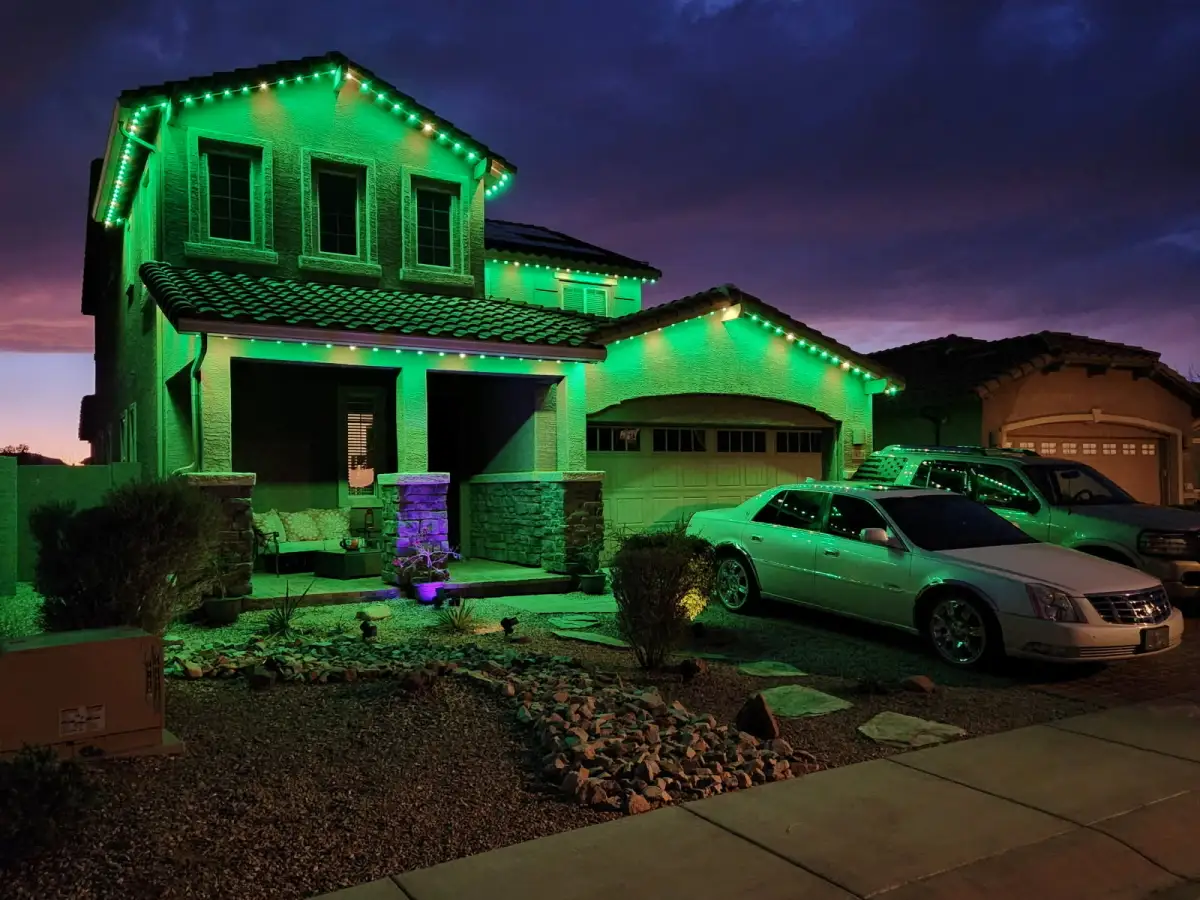
| St. Patrick's Day | Green with white accents | All-green across a full roofline is heavy. Break it with white at the corners. |
| Easter and spring | Pastel purple and soft yellow, low brightness | Pastels need the brightness down or they wash out to white. |
| Memorial Day, Veterans Day | Red, white, and blue at reduced brightness | Same palette as July, deliberately quieter. |
What the roof shape decides
Two houses on the same street will not take the same display, and the reason is almost always the roofline.
On a two-story with a projecting front gable, the rake line, the diagonal running up to the peak, is the strongest feature you have. It is the only diagonal on the house and it is what gives the elevation shape after dark. Lighting the horizontal eave and skipping the rake produces a flat band across the front and leaves the tallest part of the house dark.
On a single-story ranch, you have one long horizontal and very little else. That is a case for restraint: lower brightness, two colors at most, and any accent work moved down to the entry and the garage face rather than added to the roofline.
On a house with a deep porch or covered entry, the porch roof is a separate zone whether or not you paid for it as one. It sits forward of the main roofline and reads at a different depth, which is why running it on the same scene as the rest of the front makes the entry disappear.
Brightness, neighbors, and the things that generate complaints
Three settings cause nearly all the friction, and all three are avoidable.
- Strobe and lightning effects. Fun for one evening, genuinely disruptive to the house across the street for a month. If you use them, use them for an hour, not a season.
- Full brightness on color. Saturated color at maximum output is harsher than warm white at the same setting, and it is what people mean when they say a display is too bright. Colors generally want less output than white does.
- No off time. Set a nightly schedule. Lights that shut off at a reasonable hour are the single most persuasive thing you can offer a neighbor or a review board, and if you are in a covenanted neighborhood, volunteering it up front is worth more than arguing about it later. What a board actually wants to see is covered in what to submit to an HOA for permanent roofline lights.
Get the schedule in before the season, not during it
The practical failure mode is not choosing bad colors. It is arriving at the first week of December, realizing the scene is not built, and running whatever preset is closest. Schedules can be set months out. Build the holiday scenes in the fall, set the dates, and the house handles the rest of the year on its own, including the ones that are easy to forget, like Memorial Day and the week of a graduation.
If a scene is not working and you cannot tell why, it is usually one of two things: too many colors on one run, or the brightness too high for the color you chose. Drop one, then the other.
TruLight installs permanent holiday lighting on app-controlled roofline systems across the Omaha metro, and sets up the first round of scenes with you during the walkthrough rather than leaving you to find them yourself.
Related Articles
Permanent Christmas Lights Cost in Omaha, NE: 2026 Pricing Guide
Permanent Christmas lights in Omaha usually cost $1,500 to $4,500 for most homes. See price ranges by roofline length, story count, track type, and holiday-light savings.
Permanent Outdoor Lighting vs. Traditional Holiday Lights in Omaha: Which Wins?
How Much Does Permanent LED Lighting Cost in Omaha, NE? (2026 Pricing Guide)
Permanent LED lighting cost in Omaha ranges from $1,500 to $4,500 for most homes. This guide breaks down pricing by roofline length, system type, and what's included in a professional install.
Ready for an Omaha Roofline Lighting Estimate?
Call TruLight Omaha for a measured roofline estimate.
(402) 704-8151