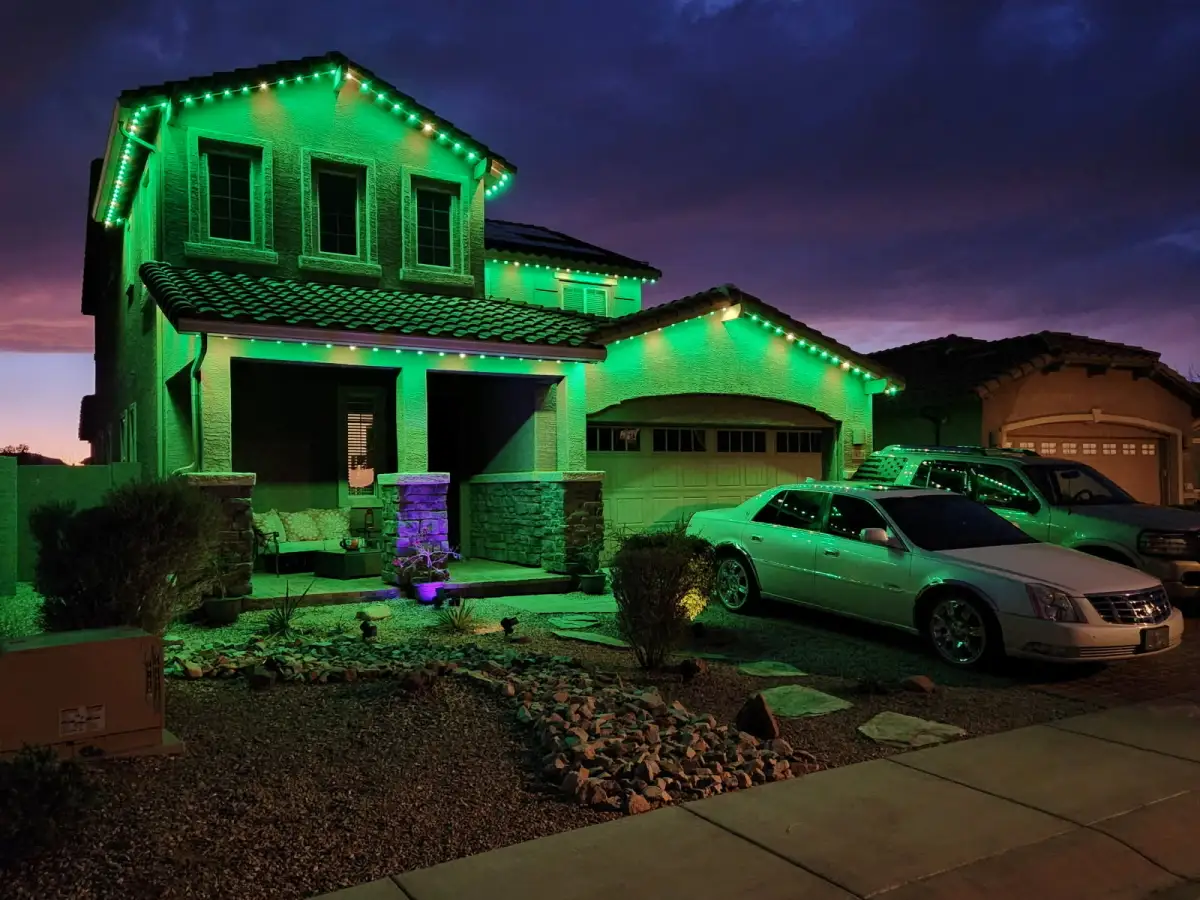
What Happens to Your Permanent Lighting When a Hailstorm Forces a Roof Replacement?
A hailstorm that takes your roof usually takes the lighting track with it, one way or another. What actually has to happen before a tear-off, who handles it, and what to ask your insurer.
In most cases, the lighting track along your fascia has to come down before a full tear-off starts and go back up once the new roof is on, the same way gutters do. It isn't automatic and it isn't usually included in the roofing crew's scope, so the part that actually matters is making sure someone plans for it before the old roof comes off, not after.
Why does the lighting need to come down for a reroof at all?
Because a full tear-off strips the roof down to the decking, and the fascia board the lighting track is clipped to sits right at the edge of that work. A roofing crew tearing off shingles, replacing decking where needed, and setting new drip edge along the eave needs that fascia line clear to work cleanly, the same reason gutters typically come off first on a full reroof. The track itself is a low-voltage clip system, not something wired into the roof deck, which is exactly why it can come down and go back up without touching the roofing work itself.
Does a partial repair change any of this, or only a full tear-off?
Only the section of fascia the repair actually touches, in most cases. A localized hail repair, patching a section of shingles or replacing a run of damaged flashing without stripping the whole roof, generally only requires detaching the lighting track directly along that section, not the whole run around the house. If the repair is contained to one slope or one section of eave, a lighting installer can usually unclip just that stretch, let the repair happen, and reset it without touching the rest of the system. It's still worth mentioning to whoever's doing the repair before they start, since "just that section" is easy to say and less easy to guess correctly from the ground.
Who takes it down, the roofer or the lighting company?
That depends on the roofer, and it's worth asking directly rather than assuming either way. Some roofing crews will detach and reset gutters and low-voltage fixtures as part of a full tear-off; many will not, and expect the homeowner to arrange it separately with whoever installed the lighting. Neither answer is unusual. What matters is finding out before the crew shows up, since a system that gets pulled down carelessly by someone unfamiliar with it is a lot more likely to need repair afterward than one a lighting installer removes and stores properly for the few days the roof is open.
Does homeowners insurance pay to take the lighting down and put it back?
Usually not directly, and that's worth knowing before the claim gets finalized rather than after. A hail claim covers the roofing system itself, the shingles or panels, underlayment, and often the gutters if they were damaged. A permanent lighting system is something the homeowner added to the house, not part of the roof the insurer is replacing, so removal and reinstall of the lighting is typically the homeowner's cost to arrange, separate from the roofing claim, in the same way a satellite dish or a security camera bolted to the eave would be. Policies and adjusters vary, so a direct question to your insurer or adjuster about what the claim scope actually includes is worth five minutes before you assume either way.
Can hail damage the lighting system itself, separate from the roof?
Yes, and it's one of the more common ways a system gets damaged in this part of the country. The full mechanics of that are covered here: a module seated in a channel under the drip edge is largely protected from a direct hit, while a bulb or fixture that sits proud of the fascia takes the impact straight on. A storm big enough to force a roof claim is also big enough to crack lenses or snap clips on any lighting that wasn't installed with that geometry in mind, so it's worth a look at the lighting itself, not just the roof, once the storm passes.
What should you tell your roofer and your insurance adjuster before the tear-off starts?
Tell both of them the lighting exists and ask directly whether removing and resetting it is included in what they're doing. For the roofer, that's a scheduling and access question, so their crew doesn't damage or discard something that needs to go back up. For the adjuster, it's a scope question, so you know before the claim is finalized whether the lighting removal and reinstall is something you're arranging and paying for separately. It also helps to have a few current photos of the lighting run before anyone touches it, both for the claim conversation and for whoever resets it afterward, since a photo settles exactly how a run was laid out far better than memory does once the roof has been open for a week. Handled that way, the reroof itself doesn't have to be the reason the lighting comes down for good.
Does a full reroof after storm damage change the lighting job differently than a planned reroof?
Not in terms of the wiring or mounting itself; only in timing. A planned reroof or new build gives everyone weeks of notice and an open framing schedule, which is the easiest window there is for this kind of install. A storm-driven claim compresses that timeline, since the roofer is often working against an insurance deadline and weather, so the lighting side of it, the take-down, the storage, and the reinstall, usually has to move faster and get coordinated on shorter notice rather than planned months out.
If a storm has already put your roof into a claim, or you're bracing for one, get the lighting side of it looked at before the tear-off is scheduled, not after. A system that's already scoped for takedown ahead of time is a lot less likely to need real repair when it goes back up, and if repairs are needed either way, that's exactly what a service visit sorts out.